



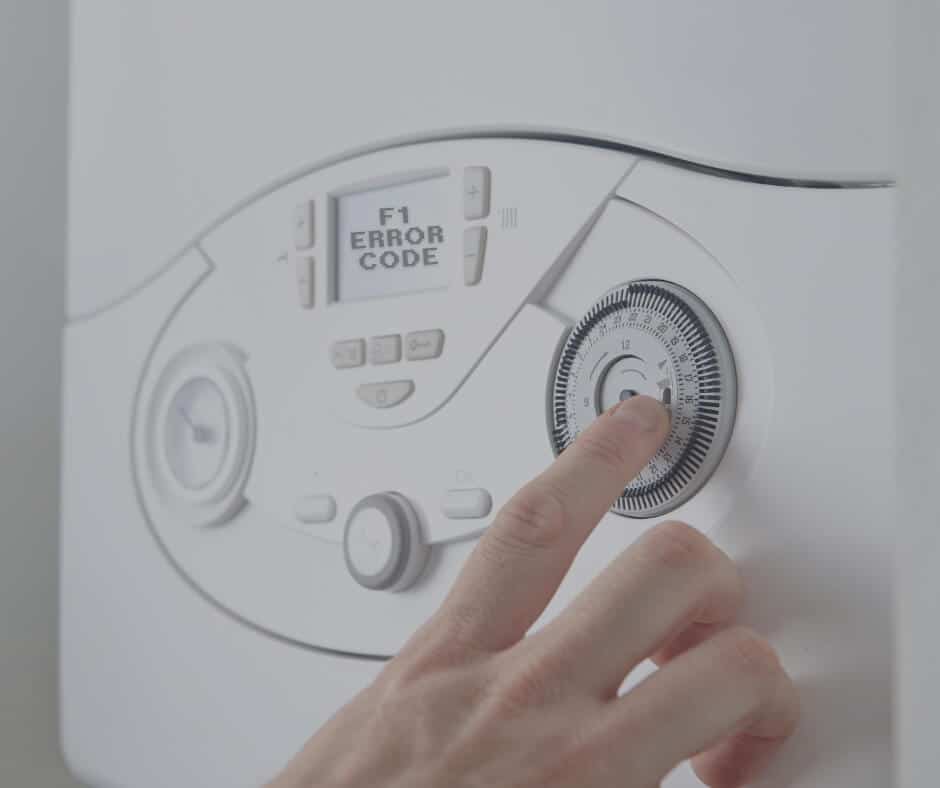
26 Nov What Does F1 Mean on a Boiler? Common Causes and Fixes
If your boiler suddenly stops working and flashes an F1 error code, don’t worry; it’s a common issue. At PEBS, we see this boiler fault frequently across modern boilers, especially Ideal boilers and combi boilers.
In this guide, we’ll explain what F1 means on a boiler, the common causes and fixes, and when to call a qualified Gas Safe engineer to safely restore your central heating system to normal operation.
What Does the F1 Error Code Mean?
The F1 fault code typically appears when there’s low boiler pressure or a faulty pressure sensor inside your heating system. Boilers rely on a stable pressure range (usually within the green zone on your boiler’s pressure gauge) for normal operation.
If the pressure drops, the boiler shuts down to prevent damage to vital internal components such as the heat exchanger or printed circuit board.
Most Ideal boiler models and combi boilers display the F1 boiler fault when water pressure falls below 1.0 bar, meaning your boiler’s pressure gauge reads too low for efficient heating system performance.
Common Causes of the F1 Fault Code
Here are the common causes and fixes we encounter when customers report the F1 error or boiler fault code during boiler service visits.
1. Low Boiler Pressure
The most common trigger for an F1 error code is low water pressure in your central heating system. Over time, boiler pressure can decrease due to small leaks, bleeding radiators, or loose joints in the copper pipework.
Symptoms:
- Boiler loses pressure or pressure drop visible on the boiler pressure gauge
- Radiators not heating properly
- Hot water running inconsistently
Fix:
Repressurise using the filling loop valve beneath your boiler unit. Open it slowly until your boiler’s pressure reaches the normal range (1.2–1.5 bar).
If your boiler continues to lose pressure, this may suggest a hidden leak or damaged pressure sensor requiring inspection by a Gas Safe engineer.
2. Hidden Leaks or Water Loss
A leaky heating system is another major cause of pressure loss. Hidden leaks, loose joints, or corroded copper pipework allow water pressure to drop over time.
Check for:
- Visible leaks beneath the boiler casing
- Damp patches near radiators or skirting boards
- Water damage around valves or fittings
If you can’t find the hidden water leak, our qualified engineers can trace and repair leaks safely. Remember: continuous pressure loss means your entire system may not be running smoothly, leading to costly repairs later.
3. Faulty Pressure Sensor or Switch
A faulty pressure sensor can misread the system’s pressure levels, tricking the boiler into thinking there’s a pressure drop when there isn’t.
Sometimes, pressure sensors become blocked by debris or fail electrically. Faulty sensors or damaged pressure sensors should only be replaced by a qualified Gas Safe engineer, as this involves handling internal components and boiler wiring.
4. Air Trapped in the Heating System
When trapped air builds up in heating systems, it disrupts boiler pressure and circulation. After bleeding radiators, pressure can temporarily fall below the normal range, triggering an F1 error.
Fix:
- Bleed radiators to release trapped air
- Check the pressure gauge again if low, top up using the filling loop
- Restart your boiler and monitor for pressure loss
5. Ignition or Sensor Faults
Some boiler systems display F1 error codes due to faulty sensors, flame detection issues, or boiler components like electrodes. These issues affect ignition and normal operation, meaning your boiler shuts down for safety.
A qualified engineer should inspect internal components such as the heat exchanger, printed circuit board, and sensors to determine whether replacement or recalibration is needed.
How to Fix an F1 Error Code: Step-by-Step
Before calling a boiler engineer, there are a few safe steps you can take to fix the F1 fault.
Step 1: Check the Boiler’s Pressure Gauge
Look at your boiler’s pressure gauge; if the needle is below 1.0 bar, your boiler’s water pressure is too low.
To increase boiler pressure:
- Turn off your boiler and allow it to cool.
- Open the filling loop valve to let water into the system.
- Watch the pressure gauge climb to the green zone (1.2–1.5 bar).
- Close the valve and restart the boiler.
If your boiler loses pressure again, it’s likely there’s a hidden leak or faulty sensor.
Step 2: Bleed Radiators
After topping up pressure, bleeding radiators can remove any trapped air in the central heating system. Always check the boiler pressure again after bleeding; it may drop slightly and need a top-up via the filling loop.
Step 3: Inspect for Leaks
Check your entire boiler system for visible leaks, especially around radiator valves, copper pipework, and the boiler casing. If you spot small leaks, call a plumbing or heating engineer to repair leaks professionally and prevent further pressure drops.
Step 4: Reset the Boiler
Once the boiler pressure is within the normal range, use the reset button to clear the error code. Most modern boilers will resume normal operation immediately if the issue is resolved.
Step 5: Contact a Qualified Engineer
If you’ve tried these steps and still see the F1 fault code, contact a qualified Gas Safe engineer. Persistent F1 boiler faults may indicate issues with pressure sensors, internal components, or the heat exchanger, all of which require expert attention.
Preventing the F1 Error Code from Returning
The best defence against recurring boiler fault codes is regular maintenance. At PEBS, we recommend an annual boiler service to ensure your entire system stays in normal operation and maintains boiler efficiency.
Prevention Tips:
- Schedule an annual boiler service with a Gas Safe engineer
- Monitor pressure levels monthly, especially in winter
- Check for hidden leaks or small leaks periodically
- Keep your boiler’s pressure gauge in the green zone
- Avoid DIY fixes involving internal components
Routine servicing keeps your boiler running smoothly, reduces pressure loss, and can delay the need for a new boiler.
How PEBS Can Help
At PEBS, we’re experts in diagnosing and fixing boiler systems across the UK. Whether you’re dealing with low pressure, a faulty pressure sensor, or a broken boiler, our team of qualified Gas Safe engineers can help.
We offer:
- Boiler repairs and servicing
- Central heating maintenance
- New boiler installations
- Efficiency upgrades for combi boilers and modern systems
Get in touch with us today to find out more about our heating solutions and to learn more about keeping your heating system safe and efficient.